
Rebuilding Gaza - Now What?
With tens of millions of tons of debris, disputed land rights, and a collapsed economy, Gaza’s reconstruction depends on radical thinking—and a long-term vision that politics has yet to deliver.
Last week, urban planners, engineers, and economists gathered for an urbanOvation ‘Reality Check’ on Gaza's reconstruction. The session was by moderated by urbanOvation founder, Bill Kistler and opened with presentations by urban strategist Chris Choa and Palestinian planner Shireen Shelleh. This was followed by an animated conversation with all participants that put politics, blame, and grievances aside. Designing the future of a place still buried under rubble may seem a futile exercise but it proved to be a thoughtful exploration of one of the most complex urban reconstruction challenges since the Second World War.
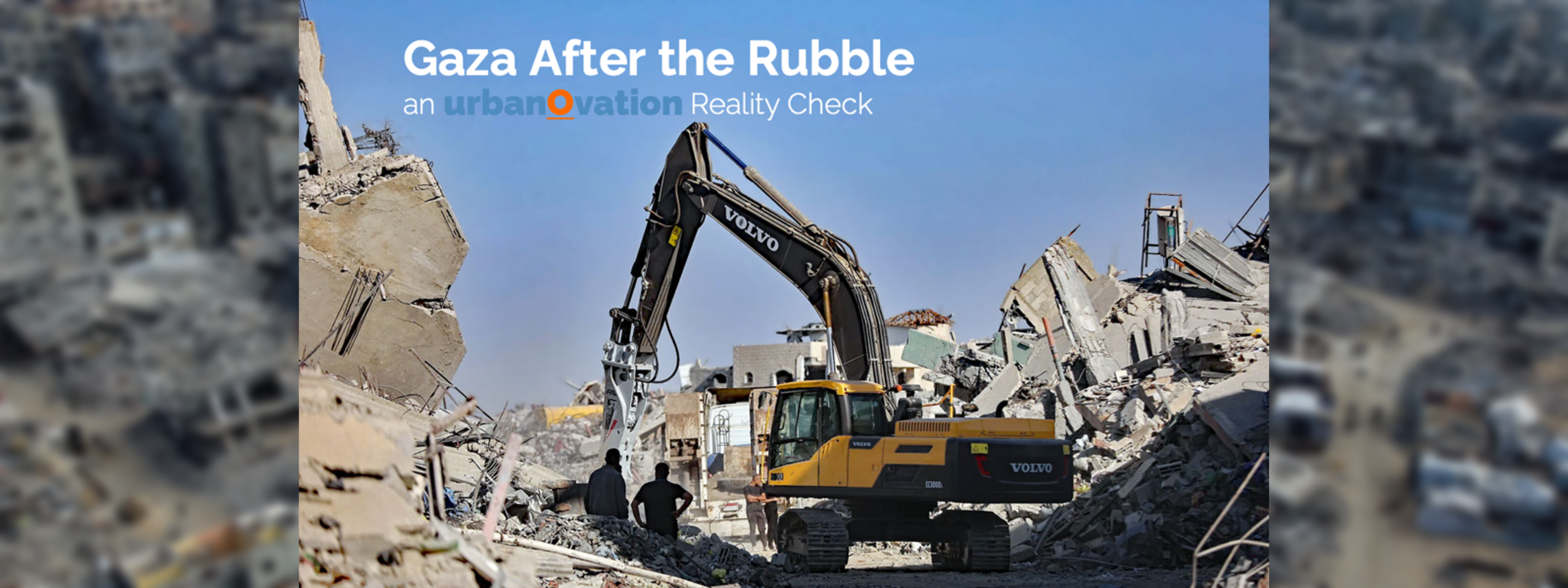
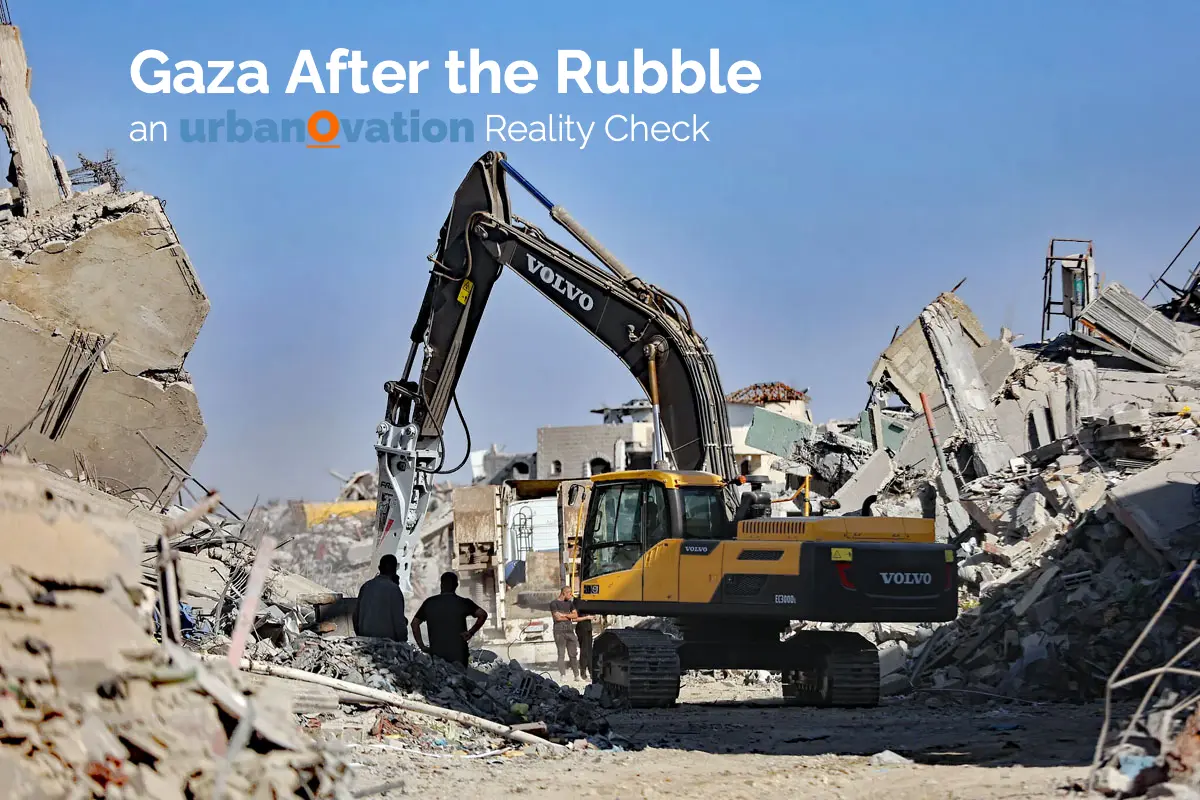
The numbers are staggering. According to multiple recovery assessments, 71% of Gaza's housing stock, 94% of water and sanitation infrastructure, 84% of energy systems, and 78% of roads have been damaged or destroyed. Complicating matters is up to 50 million tons of debris, equal to approximately 17 Great Giza Pyramids. Choa noted, clearing that volume would require 600 hectares of scarce land, to stage and sort rubble, conflicting with the location of temporary communities and infrastructure, likely impossible in one of the world's most densely populated areas.
A Battle of Plans
Choa summarised five categories of emerging reconstruction plans:
- International NGO plans which primarily focus on early recovery;
- US-sponsored proposals with economic detail but political blind spots;
- Israeli plans that reorient Gaza toward Egypt while severing West Bank connections;
- Arab initiatives that build on established concepts but often lack spatial coherence; and
- Palestinian-led frameworks, including the Phoenix Plan and Palestine Emerging.
He explained that unlike the other plans Palestine Emerging’s ambition represents the vision of the Palestinian private sector. "After October 7, 2023 no one wanted to talk," he recalled. "But a group of us came together to think 30 to 50 years into the future, and work backwards from there." This long-term planning challenges what he called the "embargo on vision" that has characterized previous decades.
Sequencing the Impossible
Shelly Culbertson from the RAND Corporation, whose team produced the influential "Camps to Communities" study, outlined six fundamental precursors to reconstruction that, if neglected, could delay recovery for decades. Property rights top the list. "Every piece of land in Gaza is owned by someone, and yet it's going to have to be treated as a public site," she observed. Without clear legal frameworks, thousands of disputes could stall progress, as seen in Mosul and Syria.
Materials restrictions present another barrier. Israel's ‘dual-use’ policies have prevented basic construction materials from entering Gaza for security reasons. Financing structures, workforce development, and the management of hazardous waste mixed with human remains round out the challenges. UNDP estimates rubble clearance could take 20 years if political and security impediments persist, or seven years under optimal conditions.
The Temporary-to-Permanent Trap
One of the greatest challenges discussed centred on temporary housing. History suggests that what begins as emergency shelter often becomes permanent. Kobi Ruthenberg from RAND emphasized the need to think about camp location and scale strategically: "Trying to find locations that are modestly damaged at the peripheries of the cities, where you would expect the cities to grow regardless of the war." He recommended community hubs serving 20,000 to 40,000 people—the scale of a neighborhood—rather than massive camps that prove unmanageable.
Shelleh reinforced this: "We don't want to settle people in places where very important projects should be in the future... even if they're not finished for years." This reflects Gaza's need to protect future infrastructure corridors—industrial zones, energy networks, mobility systems—from being blocked by informal settlements that turn into permanent slums.
A participant from Lebanon added a sobering warning: "If the wrong areas become informal camps, they stay that way for decades. The first six months of placement determine the next 20 years of urban form."
Economic Restart and the Missing Middle
Gaza's economy has collapsed: 98% of businesses are affected, 66% destroyed, GDP has contracted 83%, and youth unemployment exceeds 60%. Reconstruction plans outline $18.4 billion in economic sector investments across industry, commerce, and finance. Yet as Choa observed, most plans focus either on emergency relief or long-term megaprojects, and not what he called the "missing middle"—investible, scalable projects that bridge humanitarian response and private-sector revival.
Palestine Emerging's "game changers" aim to fill this gap: reconstructed industrial zones, transport infrastructure, and a long-term coastal strategy including a deep-water port potentially built on reclaimed land using recycled rubble. Shelleh emphasized “These projects must be investible, not just aspirational and that the private sector has major role in the reconstruction of Gaza”.
Governance: The Reconstruction Fund Question
When discussion turned to the proposed Reconstruction Fund, Shelleh noted underlying political tensions. The fund, being developed in cooperation with the World Bank will have a separate independent board to ensure transparency and counter donor concerns about corruption.
The Megacity Thesis
One of Choa's more provocative arguments challenged conventional thinking about Palestinian statehood. "Focusing on establishing the independent state, while important emotionally and politically, should not be the end goal," he argued. Instead, he envisions Gaza as part of a mega-metropolis encompassing 20 million people, incorporating not just the West Bank but extending north to Beirut and Damascus, and east to Tel Aviv, Jerusalem and Amman. Gaza could become like a Brooklyn to the five boroughs of New York, with its own style, its own culture, but really trading as part of a much larger urban region."
This vision faces obvious political obstacles. Yet Hugh Roberts raised a fundamental point about urban viability: "Urbanism depends on hinterlands, both physical, but also social and demographic." Without connectivity—either to the West Bank, or through trade with the broader Arab world—Gaza risks becoming an economically unviable city-state, regardless of reconstruction quality.
De-risking the Uninsurable
Samer Bagaeen, citing his experience with Ramallah's resilience strategy, identified the core investor dilemma: "The risk is highest at the beginning." Rubble clearance, master planning, and ground preparation generate no revenue. Without coalition funding upfront and political risk insurance mechanisms—potentially backed by the World Bank or consortium guarantees—private capital won't engage. "Who insures a building in Gaza?" Choa asked rhetorically. "Currently, nobody."
Shelleh concurred, emphasizing that stability and open borders for materials are prerequisites for any serious investment. She advocated for de-risking instruments that allow international donors to backstop private-sector loans, regional and local, creating confidence where none currently exists.
The Urgency of Vision
The session closed with a shared recognition that Gaza's reconstruction will be complex, multi-decade, and deeply interdependent. Ahmed Elfarra posed the central question: “How can housing, rubble clearance, materials supply, workforce mobilisation and financing be organised as one interconnected delivery system rather than repeating the siloed approaches that have weakened previous recovery efforts in Gaza and elsewhere?”
Choa's answer returned to the paradox that opened the discussion: "This is why it's so important, even though the local emergency is so strong, for some people not to focus on immediate recovery. We have to have a 30, 40, 50-year view. Because without that view, we can be blinded by things we urgently need to do now." The temporary, he warned, becomes permanent. A camp for urgent shelter today may block the transit corridor or power infrastructure needed tomorrow.
Shelleh closed with both frustration and determination noting the urgency to move quickly, to push for planning, and to push for the main players to play a constructive role.
The urbanOvation gathering produced no breakthroughs, secured no funding, resolved no political disputes. Yet it demonstrated something valuable: that serious planning can proceed even when political resolution seems distant. The rubble will be cleared eventually. Communities will form somewhere. Infrastructure will be rebuilt somehow. The question is whether these inevitable actions occur through improvisation and reactive crisis management, or according to a coherent spatial vision that makes ordinary life possible again—and creates the physical facts that might, just possibly, enable the political settlement that currently seems impossible.